
English 
Landline:
+86-571-8233-3525
Telephone:
Telephone:
+86-150-6710-5089
+86-138-6743-1140
Address:
Building 41 workshop, No.17, Xueyuan road, Jiyang street, Zhuji city, Zhejiang Province, China


Views: 0 Author: Site Editor Publish Time: 2026-09-08 Origin: Site


Messy food inevitably leaves customers with sticky hands. Offering a quick cleanup solution is essential. However, buying retail hygiene products severely hurts your profit margins. Retail prices drain a restaurant's operational budget rapidly. You need a better procurement strategy right now. This guide breaks down the technical nuances of wholesale buying. We cover hidden logistics costs, factory vetting, and specification standards that elevate the dining experience while protecting your bottom line.
Transitioning to a direct-to-factory procurement strategy slashes per-unit costs and stabilizes inventory during peak dining hours.
Accurately calculating daily customer volume against messy food orders is mandatory for negotiating Minimum Order Quantities with manufacturers.
Single-use packets provide superior moisture retention and cross-contamination protection compared to multi-pack dispensers.
Evaluating physical samples for spunlace fabric thickness, scent profiles, and composite packaging integrity prevents costly bulk purchasing mistakes.
For growing food service establishments serving BBQ, seafood boils, or finger foods, hygiene amenities are an operational necessity. Relying on retail channels or third-party consumer distributors introduces massive markups. Transitioning to a direct wholesale model is a strategic financial decision. It heavily impacts unit economics and standardizes the guest experience.
The primary driver for factory-direct purchasing is the drastic reduction in cost per unit. When buying through standard cash-and-carry stores, restaurants absorb the costs of middleman logistics and consumer retail markups. A standard wipe might cost upwards of $0.05 to $0.10 per unit. By engaging directly with a manufacturer, that cost plummets to fractions of a cent.
Consider a mid-sized seafood restaurant serving 300 customers daily. If a large portion of customers require at least two wipes after cracking open crab legs, daily usage sits around 480 wipes. Paying retail prices could cost over $14,000 annually. In contrast, securing a wholesale rate of $0.02 per wipe drops that annual expense to roughly $3,500. This single supply chain shift yields an annual savings of over $10,500. That is capital directly injected back into your kitchen operations.
Beyond unit economics, bulk purchasing shields restaurants from supply chain volatility. Consumer retail markets constantly face sudden stockouts and seasonal price inflation. By establishing a wholesale contract, procurement managers lock in pricing. Buying by the pallet ensures the restaurant maintains a healthy buffer stock. This stability prevents the operational embarrassment of running out of basic supplies during peak summer BBQ months.
The commercial food service wipes market is experiencing a profound shift. Post-pandemic consumer behavior dictates that diners now equate visible sanitation efforts with overall kitchen quality. Market analyses indicate a surging demand for premium hygiene products in casual dining sectors. Restaurants are rapidly replacing generic dry napkins with moistened, branded wipes. This acts as a cost-effective method to signal high cleanliness standards.
In addition, a major procurement trend is leaning toward eco-friendly substrates. Consumers expect sustainability. Offering biodegradable wipes proves that a cleanup tool is no longer just a commodity. It is a critical touchpoint in brand perception.
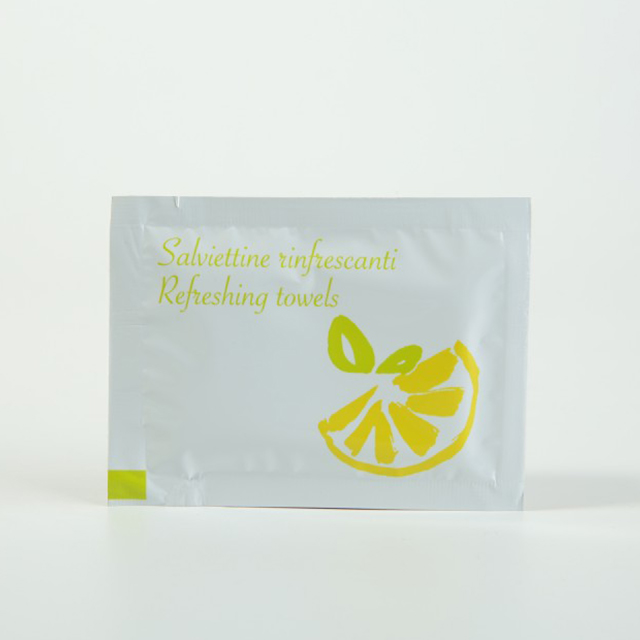
The commercial wipe market offers various formulations tailored to different dining environments. Selecting the correct specification requires an engineering approach to your specific menu. Below is a technical breakdown of standard options available for bulk procurement.
The lemon-scented wipe is the ubiquitous standard in the global hospitality industry. From a chemical standpoint, the citrus profile effectively neutralizes stubborn food odors left behind by shellfish and smoked meats. Lemon extract acts as a mild astringent. It cuts through heavy grease on the skin without leaving a sticky residue. When sourcing bulk lemon restaurant wet wipes, verify the formula uses Reverse Osmosis pure water. The fragrance must be perfectly balanced to mask odors without overpowering the palate.
While multi-draw dispenser packs exist, single-use packets are structurally superior for commercial dining. They eliminate cross-contamination risks. Operationally, servers can easily drop them into takeout bags or set them on table settings.
More importantly, investing in bulk individual packet restaurant wet wipes guarantees optimal moisture retention. Dispenser packs dry out once the main seal breaks. Individual sachets lined with composite PET and aluminum film ensure the product remains perfectly saturated from the factory floor to the dining table.
Buyers must distinguish between standard cleansing wipes and antibacterial variants. Standard wholesale hand cleaning restaurant wet wipes rely on mild surfactants and water. They physically remove grease and sticky sauces. Antibacterial wipes contain active pharmaceutical ingredients to kill germs, subjecting them to stricter regulatory oversight. For general dining cleanup, standard surfactant-based wipes are highly effective, skin-friendly, and far more cost-efficient.
To simplify your procurement decision, reference this technical comparison of common wipe configurations used in the food service industry.
Product Type | Recommended Material Spec | Key Formulation | Best Dining Scenario |
|---|---|---|---|
Lemon Scented Single-Packet | 40-50 GSM Spunlace Non-woven | RO Pure Water, Lemon Extract, Mild Surfactant | Seafood boils, BBQ joints, Chicken wing restaurants |
Unscented Hand Cleaning Wipe | 45 GSM Spunlace Non-woven | RO Pure Water, Aloe Vera, Vitamin E | Fine dining, Sushi bars, High-end steakhouses |
Multi-Pack Dispenser | 35-40 GSM Standard Non-woven | Standard Water, Basic Cleansing Agent | Back-of-house staff cleanup, Drive-thru windows |
Committing to a wholesale order means purchasing tens of thousands of units. Evaluating a physical sample against specific quality metrics is non-negotiable. Do not finalize an order without testing these parameters.
The physical fabric dictates durability. The industry standard metric is Grams per Square Meter. Paper-thin wipes under 35 Grams per Square Meter tear instantly against greasy hands. This leads to immediate customer frustration. For heavy-duty food service, spunlace non-woven fabric is mandatory. Aim for a 40 to 50 Grams per Square Meter specification. It seamlessly blends polyester and viscose to create a tear-resistant, cloth-like texture.
A wipe is useless if the liquid evaporates during transit. Inspect the inner lining of the wrapper. High-quality options utilize a multi-layer composite film containing a thin layer of aluminum to block moisture transfer and UV light. During sample testing, apply firm pressure to the packet. Check for microscopic air leaks along the heat-sealed edges. Ensure the tear-notch opens smoothly without requiring excessive force.
Because diners apply these directly to their skin, the liquid formulation must be hypoallergenic. Always request the Material Safety Data Sheet. Look for pH-balanced formulations. The absence of harsh parabens or heavy alcohols prevents skin drying. Additives like Aloe Vera extract serve as excellent quality indicators.
A wet wipe is a highly visible piece of marketing real estate. It sits directly in front of the customer for the duration of their meal.
Private labeling involves printing your proprietary logo onto the outer wrapper. The cost per impression is exceptionally low. Including vivid brand colors and website URLs turns a generic commodity into a brand reinforcement tool. When customers store extra wipes in their cars, your restaurant’s brand remains visible, actively driving repeat orders.
Implementing custom branding requires coordination with the manufacturer. Submit high-resolution vector files of your logo. The factory will perform color matching using Pantone codes. Once you approve the digital mockup, the factory creates flexographic printing plates. Custom printing usually extends the initial production lead time by one to two weeks.
Determining the exact volume of hygiene products is a delicate balancing act. Over-ordering ties up operating capital. Under-ordering leads to stockouts.
Establish an accurate baseline for daily usage based on your menu. Use this standard procurement formula. Multiply your average daily customers by the percentage of those ordering messy foods. Then multiply that figure by the estimated wipes used per person.
If a burger joint serves 500 customers daily and 70 percent order messy foods, 350 diners need wipes. If each uses an average of 1.5 wipes, the daily requirement is 525 wipes. That totals roughly 15,750 wipes per month. A smart procurement manager will order a three-month supply to optimize freight costs.
Manufacturers enforce Minimum Order Quantities to cover the setup costs of production lines. Generic unbranded wipes typically have lower thresholds, starting around 10,000 units. Custom-branded wrappers require higher volumes, generally ranging from 30,000 to 50,000 units. If a supplier's threshold exceeds your storage capacity, negotiate split shipments. The factory produces the full batch but ships inventory in staggered monthly deliveries.
Transitioning to a factory-direct model requires strict due diligence. Partnering with an unverified supplier results in delayed shipments or non-compliant ingredients.
A reputable manufacturer operates with full transparency. Request copies of their facility certifications. ISO 9001 guarantees a standardized quality management system across different batches. Good Manufacturing Practice certification ensures hygiene products are produced in clean, controlled environments. FDA registration is required if the wipes carry specific antibacterial claims.
The quoted price on the factory floor is only part of the total landed cost. Clarify logistics before signing a purchase order. If buying overseas, request Delivered Duty Paid pricing. Under these terms, the supplier handles all ocean freight, import duties, and final truck delivery straight to your restaurant door.
Securing a great wholesale deal is only half the battle. Protecting that investment through proper storage is critical. Improper environmental conditions will rapidly degrade the chemistry and packaging of your restaurant wet wipes.
Extreme heat is the primary enemy of bulk inventory. Storing cartons next to industrial kitchen ovens causes the liquid solution to evaporate. Heat also compromises the packet's adhesive seals. Freezing temperatures cause the water-based solution to separate. Store bulk cartons in a climate-controlled, dry area between 59°F and 77°F. Keep them off the floor on pallets and away from direct sunlight.
Commercial wipes carry a manufacturer-guaranteed shelf life of 12 to 24 months. Implement a strict First In, First Out inventory system. When a new shipment arrives, place the fresh boxes behind the existing stock. Train staff to pull cases from the front. This rotational practice ensures customers always receive a fresh, fully saturated product.
Upgrading your procurement strategy to buy wholesale is a highly effective way to save capital while improving dining operations. By specifying the correct material thickness, negotiating direct shipping terms, and leveraging custom branding, you transform a basic cleanup tool into a powerful asset. Always demand physical samples and verify factory certifications. Ready to optimize your supply chain? Evaluate your current usage, determine your ideal specifications, and visit professional manufacturers like ZJ Wipes to request your initial sample pack today.
The standard shelf life is typically 12 to 24 months, provided they are stored correctly. Longevity depends heavily on the packaging material. Foil-lined individual packets retain moisture much longer than standard plastic wrappers. Store master cartons in a cool, dry environment away from extreme temperature fluctuations.
Yes. The vast majority of wholesale manufacturers offer private labeling services via flexographic printing. You must meet the manufacturer's Minimum Order Quantity for custom prints, which usually ranges from 30,000 to 50,000 units. You will need to provide your artwork in a high-resolution vector format.
Generally, no. Heavy-duty food service wipes are manufactured using spunlace non-woven fabrics containing synthetic polyester and viscose. These fibers do not dissolve in water. Flushing them causes severe plumbing blockages. Always dispose of them in standard waste receptacles.
From a strict cost-per-wipe perspective, multi-pack dispensers are slightly cheaper due to reduced packaging material. However, individual packets are vastly preferred for restaurants. They prevent cross-contamination, offer precise portion control, and provide a premium presentation for guests.
Absolutely. For small restaurants, custom-branded wipes act as low-cost, high-retention marketing tools. The cost difference between generic and custom wipes is often fractions of a cent per unit at wholesale volumes. When customers take leftover wipes home or keep them in their cars, it creates ongoing brand visibility that far outweighs the initial printing plate investment.
Grams per Square Meter measures the density and thickness of the wipe. For light messes like cafe pastries, a 35 GSM wipe is sufficient. For heavy, greasy foods like BBQ ribs, seafood boils, or burgers, you need a minimum of 40 to 50 GSM spunlace fabric. Lower GSM wipes will tear under friction, forcing customers to use multiple wipes and ultimately costing you more money.


