
English 
Landline:
+86-571-8233-3525
Telephone:
Telephone:
+86-150-6710-5089
+86-138-6743-1140
Address:
Building 41 workshop, No.17, Xueyuan road, Jiyang street, Zhuji city, Zhejiang Province, China


Views: 0 Author: Site Editor Publish Time: 2026-09-16 Origin: Site


Did you know a simple wet wipe can fundamentally change a diner's entire experience? Picture this. A guest just finished a towering plate of sauce-slathered ribs. They reach for a complimentary wipe. Instead of cleaning their hands, the material shreds into useless, sticky paper pills upon first use. Frustrating, right?
Yet, many restaurant owners unintentionally compromise their service quality by picking the wrong materials. Cheap substrates tear easily because they lack structural cross-linking. Meanwhile, over-engineering with ultra-premium options can silently drain profit margins. As an industry professional, you need to look beyond the surface. Understanding the engineering behind substrate thickness, moisture retention, and tensile strength is critical.
In this comprehensive guide, you will discover how to select the optimal materials to perfectly balance operational cost, customer satisfaction, and brand prestige.
Material dictates performance: The base substrate strictly determines a wipe's softness, tensile strength, and long-term operational cost.
Nonwoven fabrics are premium: Spunlace variants offer the ultimate cloth-like feel and tear resistance. They are ideal for upscale or messy dining environments.
Paper is cost-effective: Wet strength paper provides a highly budget-friendly, practical solution for high-volume fast-food and takeout services.
Packaging matters: Eco-conscious brands are strategically shifting toward rustic, unbleached kraft paper packaging to enhance their sustainable image.
Matching is crucial: The optimal choice depends entirely on your establishment's service type, menu offerings, and target budget.
In the competitive hospitality industry, every single touchpoint matters. Providing a high-quality table-side wipe elevates the perceived value of the entire dining event. When a customer finishes a meal and is presented with a substantial, thoughtfully packaged wipe, it signals meticulous attention to detail. It transforms a basic hygiene necessity into a luxurious amenity.
Conversely, consider establishments serving finger foods. The absence of a durable wipe often leads to sticky menus and soiled cloth napkins. Ultimately, this drives up daily operational overhead through inflated commercial laundry costs.
Consumer behavior has shifted dramatically in recent years. Diners now expect accessible, immediate hand sanitation directly at their table. Providing an individually wrapped wipe offers guests profound peace of mind. It demonstrates that your establishment actively prioritizes their health. Unlike communal bathroom soap dispensers, a table-side wipe delivers instant, single-use sanitation controlled entirely by the user. Consequently, this visible commitment to cleanliness directly influences customer retention and positive online reviews.
From a purely business perspective, a wet wipe functions as a miniature billboard. The packaging material and the physical substrate itself serve as a tactile branding opportunity. Custom printing your restaurant logo, social media handles, or a brief thank-you message on the wrapper reinforces brand identity right at the conclusion of the meal. Furthermore, the physical sensation of the material subconsciously communicates your market positioning. A heavy-duty fabric feels premium, while an artisanal paper wrapper screams sustainability.
Spunlace nonwoven fabric is engineered through a specialized mechanical process known as hydroentanglement. High-pressure jets of water are utilized to entangle webs of fibers. These fibers are typically a precise blend of polyester and viscose rayon. Crucially, this method binds the fibers together without relying on harsh chemical binders or thermal melting. The end result is a flexible substrate that closely mimics the texture, drape, and absorbency of traditional woven textiles. Higher viscose content yields superior softness. Meanwhile, polyester provides the necessary structural backbone.
The standout advantage of nonwoven hand cleaning restaurant wet wipes is their exceptional tensile strength. Unlike standard paper alternatives, spunlace fabric refuses to tear, pill, or leave annoying lint on the user's hands. This holds true even under aggressive scrubbing. Typical premium restaurant nonwoven wipes range from 40 to 60 grams per square meter. This robust thickness ensures the wipe remains completely intact when obliterating heavy grease, sticky glazes, or cooking oils.
Because of their cloth-like resilience, nonwoven substrates are the definitive gold standard for specific dining sectors. They are highly recommended for fine dining establishments, upscale steakhouses, vibrant seafood boils, and authentic barbecue joints. In these scenarios, diners face heavy-duty messes. A flimsy wipe would force the customer to rip open three or four packets. In contrast, a single high-density nonwoven sheet effortlessly handles the task.
Standard paper dissolves rapidly when exposed to moisture. Water breaks the delicate hydrogen bonds holding the cellulose fibers together. To circumvent this structural failure, manufacturers create wet strength paper restaurant wet wipes by treating standard wood pulp with specialized cross-linking resins. These advanced resins weave a water-resistant network within the paper. This allows the material to retain up to thirty percent of its dry tensile strength even when fully saturated. This scientific modification keeps the wipe functional without immediately disintegrating into mush.
For procurement teams focused strictly on overhead reduction, wet strength paper is the undisputed champion. The manufacturing process is highly scalable. It is also far less resource-intensive than hydroentangling synthetic fibers. As a result, these wipes are significantly cheaper to produce and acquire in massive bulk. Typically ranging from 25 to 35 grams per square meter, they offer just enough durability for light cleaning. For quick-service restaurants operating on razor-thin margins, switching to paper substrates can yield measurable annual savings on consumable supplies.
Engineered for sheer efficiency rather than luxury, wet strength paper is the optimal fit for fast-food chains, bustling food trucks, casual diners, and high-volume delivery services. In these environments, the primary objective is basic hand degreasing after eating fries, burgers, or pizza. The messes are generally lighter. The customer expectation is geared toward rapid convenience, making paper the perfect functional match.
Bamboo has swiftly emerged as a highly viable alternative to traditional synthetic blends. As a rapidly renewable grass, bamboo requires drastically less water and zero pesticides to thrive. When processed into viscose fibers and spunlaced, it creates a wipe that is naturally plush, highly absorbent, and surprisingly strong. Importantly, pure bamboo wipes are fully biodegradable and compostable under commercial conditions. They deliver a premium tactile feel without the ecological guilt.
When sourcing eco-friendly options, buyers must look beyond clever marketing jargon and demand third-party verification. Terms like natural are largely unregulated. Instead, seek out Forest Stewardship Council certification. This ensures the wood pulp or bamboo was harvested sustainably. Additionally, look for internationally recognized compostability standards to guarantee the material breaks down safely.
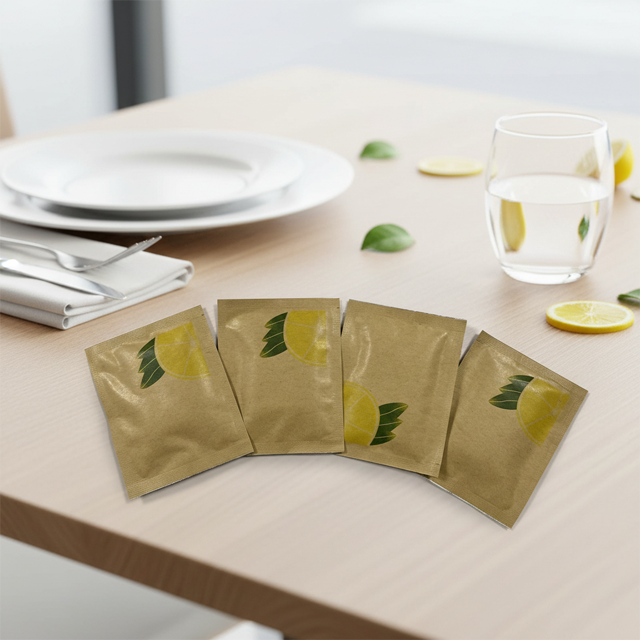
Packaging is the very first thing a customer interacts with. It sets the tone before the wipe is even used. Recently, the industry has seen a massive surge in the adoption of kraft-packaged restaurant cleaning wipes. These wrappers offer a distinct rustic, artisanal aesthetic. They perfectly complement vegan cafes, farm-to-table bistros, and trendy burger joints. The unbleached, earthy brown paper visually broadcasts a commitment to sustainability. This creates a positive brand association instantly.
Despite the growing visual appeal of kraft paper, maintaining liquid integrity is an engineering challenge. Standard paper breathes, which leads to fluid evaporation. To solve this, high-quality kraft wrappers are lined with ultra-thin polyethylene or polyethylene terephthalate films. This internal barrier creates an incredibly low moisture vapor transmission rate. It ensures the liquid solution remains trapped inside, guaranteeing a robust shelf life of up to two years without compromising the outer rustic appearance.
The liquid formula soaking the substrate is just as critical as the material itself. You may wonder why Lemon Restaurant Wet Wipes are so ubiquitous. It is not merely a fragrance preference. It is functional chemistry. Premium formulations utilize EDI purified water infused with soothing aloe vera and active citrus extracts. Natural compounds like D-limonene act as powerful degreasers. They actively slice through the lipid barriers left on hands by fried chicken, butter, or heavy sauces. Furthermore, citrus effectively neutralizes the stubborn, lingering odors associated with handling seafood and smoked meats.
The absorbency rate of your chosen substrate dictates the liquid dosage required during manufacturing. Spunlace nonwoven materials possess a high void volume. This means they can hold a substantial amount of liquid without dripping, ensuring a thoroughly saturated, effective clean. Conversely, wet strength paper has a lower saturation threshold. If over-saturated, the paper risks structural failure. If under-saturated, it feels abrasive. Manufacturers must precisely calibrate this balance.
Recent market analyses reveal a fascinating shift in hospitality procurement. Driven by both legislative pressure banning single-use plastics and changing consumer ethics, the demand for compostable substrates is skyrocketing across North America and Europe. The industry is rapidly moving away from purely functional, petroleum-based wipes. Instead, operators are adopting plant-based alternatives that align with strict environmental, social, and governance goals.
Moreover, post-pandemic hygiene habits have proven highly resilient. Diners continue to view table-side sanitation not as a temporary precaution, but as a permanent, expected standard of hospitality. Establishments that fail to provide this amenity are increasingly viewed as outdated or inattentive by modern reviewers. Upgrading to a branded, high-quality wipe is now considered a fundamental marketing investment rather than a simple operational expense.
Selecting the optimal hand sanitation product is not a monolithic process. Purchasing managers must carefully align the physical properties of the wipe with the operational realities of their specific dining environment. A mismatch can lead to either unnecessary overhead or a degraded guest experience.
In the fine dining sector, every amenity must reflect a commitment to excellence. Standard thin paper wipes are entirely insufficient here. Purchasing managers should source premium spunlace nonwoven materials with a high density rating. This provides a substantial, cloth-like tactile experience. Packaging should feature matte-finish wrappers with minimalist typography. The liquid solution should avoid generic synthetic fragrances, utilizing sophisticated scents like white tea or cedar to provide a refreshing end to the meal.
Restaurants specializing in inherently messy cuisines face a unique operational challenge. Diners consuming barbecue ribs or butter-soaked seafood require heavy-duty cleaning. Here, structural integrity is the single most critical factor. Investing in large-format, heavy-duty nonwoven wipes ensures guests can aggressively clean their hands without the substrate disintegrating. Pair this with a robust, grease-cutting citrus solution and standard foil-lined packaging that can withstand being tossed into serving baskets.
High volume, rapid table turnover, and strict margin controls dictate procurement in the quick-service sector. Because these establishments distribute thousands of units daily, cost efficiency is paramount. Wet strength paper wipes treated with food-safe resins become the ideal solution. By opting for standard glossy plastic sachets and bulk purchasing agreements, operators keep their per-unit overhead exceptionally low while still meeting baseline hygiene expectations.
Restaurant Type | Recommended Substrate | Ideal Density | Packaging Type | Primary Objective |
|---|---|---|---|---|
Fine Dining | Spunlace Nonwoven | 45 - 60+ GSM | Custom Matte Foil | Luxury tactile experience |
Messy Foods | Heavy-Duty Nonwoven | 40 - 50 GSM | Standard Plastic/Foil | Maximum tear resistance |
Fast Casual | Wet Strength Paper | 25 - 35 GSM | Glossy Plastic | Cost reduction & volume |
Eco-Conscious | Bamboo Viscose | 35 - 45 GSM | Kraft Paper | Environmental sustainability |
A common pitfall in restaurant procurement is selecting a supplier based solely on the lowest invoice cost per case. To accurately assess financial impact, operators must calculate the true cost per clean. Consider a scenario where a budget paper wipe costs a fraction of a cent, while a premium nonwoven wipe costs slightly more. If the paper wipe is too thin, a diner eating barbecue wings may require four packets to get clean. This multiplies the actual cost per customer. Conversely, the superior durability of a single nonwoven wipe suffices for the same meal. Investing in higher quality often results in lower overall consumption.
Branded packaging serves as a highly effective, low-cost marketing tool. However, customizing wrappers with specific logos introduces minimum order quantities. While standard unbranded wipes can be purchased in small batches, custom flexographic printing typically requires larger commitments to offset the initial setup fees and plate charges. Purchasing managers must assess whether their establishment possesses the storage capacity and turnover rate to justify a massive bulk order.
Procuring tens of thousands of wipes to secure a bulk discount is only sound if the inventory is properly preserved. Restaurant wet wipes generally boast a shelf life of twelve to twenty-four months. Wrappers lined with vacuum metallized films offer superior moisture retention compared to unlined alternatives. Crucially, cases must be stored in climate-controlled environments, strictly away from direct sunlight and kitchen heat. High temperatures can degrade the preservative systems, leading to dried-out substrates or bacterial growth. Always utilize the first-in, first-out inventory method.
Choosing the best material for your establishment requires a strategic balancing act between your operational budget and your brand identity. Your specific menu dictates the necessary durability of the wipe, while your customer demographic influences the packaging aesthetic. Before finalizing any bulk order, always request physical samples to personally test the tear strength and moisture levels. By making an informed decision, you transform a simple post-meal cleanup into a memorable extension of your hospitality. Ready to elevate your guest experience? Explore the full range of premium and budget-friendly solutions at ZJ Wipes to find the perfect match for your brand today.
The primary difference lies in texture, durability, and cost. Wet strength paper is an economical, wood-pulp-based material treated with resins to resist dissolving. This makes it highly cost-effective but prone to tearing under heavy friction. Nonwoven material is engineered by entangling synthetic or natural fibers with high-pressure water jets. This results in a thick, highly durable, cloth-like texture that will not easily rip, though it comes at a higher price point.
GSM stands for grams per square meter, which measures the density and thickness of the wipe. For standard fast-food applications, 25 to 35 GSM wet strength paper is sufficient. However, for a high-quality premium experience, you should look for nonwoven materials ranging from 40 to 50 GSM. Luxury dining establishments often opt for 60 GSM or higher to replicate the feel of a real cloth towel.
When manufactured with proper packaging, individually wrapped wipes retain their moisture exceptionally well. High-quality wrappers utilize an inner layer of aluminum foil or high-density polyethylene to block moisture vapor transmission. Under normal conditions, these wipes boast a shelf life of twelve to twenty-four months. However, exposing them to excessive kitchen heat or direct sunlight will accelerate evaporation and degrade the liquid solution.
The vast majority of these products are strictly non-flushable. This is especially true for nonwoven variants made from polyester or polypropylene blends. They do not break down in water and will cause severe plumbing blockages. Even products labeled as biodegradable should be disposed of in standard waste receptacles. They require specific commercial composting conditions to decompose properly and can still damage municipal sewer systems.
Yes, custom branding is highly encouraged. Kraft paper features a naturally porous surface that accepts ink beautifully, allowing for crisp logo reproduction. Printing on this material offers a distinct, rustic, and artisanal aesthetic that aligns perfectly with sustainable branding. Keep in mind that custom printing usually requires meeting a supplier minimum order quantity to offset the costs of creating the printing plates.
The ubiquitous lemon scent serves a highly functional purpose beyond simple fragrance. Citrus essential oils and synthetic lemon derivatives contain natural astringent and grease-cutting properties. When diners eat messy, oil-heavy, or pungent foods like fried chicken or seafood, the lemon scent actively neutralizes lingering food odors on the skin rather than just masking them. This leaves the hands feeling genuinely clean and refreshed.


